
Willie Mays
Hall-of-Fame center fielder for the New York Giants, referenced in the song "Talkin' Baseball."

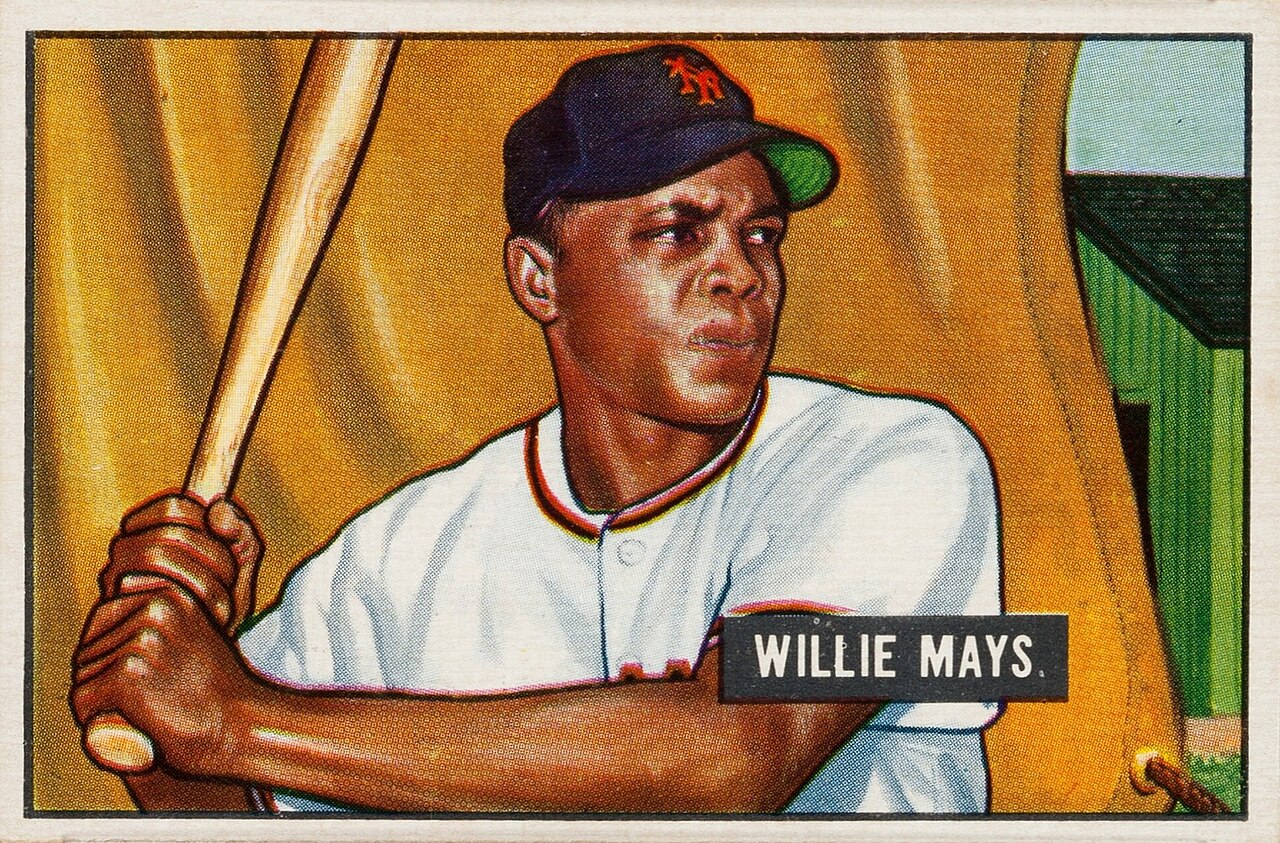
Bowman · Public domain
Willie Mays is one of the three Hall-of-Fame center fielders referenced in the refrain of Terry Cashman's 1981 song "Talkin' Baseball (Willie, Mickey & The Duke)." The song describes the history of American major league baseball from the 1950s to the beginning of the 1980s, and was inspired by a photograph of Mays, Mickey Mantle, and Duke Snider together. Mays played for the New York Giants, Mantle for the New York Yankees, and Snider for the Brooklyn Dodgers—all in the same city at the same time. The song's final chorus includes the phrase "Say hey," a reference to Mays's nickname "The Say Hey Kid."
- field
- Center fielder
Verified Timeline
Lore & Background
Willie Mays is one of the three outfielders named in the title of Terry Cashman's 1981 song "Talkin' Baseball (Willie, Mickey & The Duke)." The song was inspired by a photograph of Mays, Mickey Mantle, and Duke Snider together. Mays played for the New York Giants, Mantle for the New York Yankees, and Snider for the Brooklyn Dodgers—all at the same time in the same city. The song's refrain repeats "Willie, Mickey and the Duke," and the final chorus includes the phrase "Say hey," which refers to Mays's nickname "The Say Hey Kid." The original sheet music for the song is part of the Cooperstown Collection, and Cashman was honored at the 2011 Hall of Fame weekend.
Reader's Guide
In "Talkin' Baseball," Willie Mays is directly referenced by name in the refrain and indirectly through the phrase "Say hey" in the final chorus. The song also mentions other players and managers from Mays's era, including Bobby Thomson, Yogi Berra, Roy Campanella, and Casey Stengel. The line "Bobby Thomson had done it" refers to Thomson's 1951 Shot Heard 'Round the World, which won a playoff between Mays's New York Giants and the Brooklyn Dodgers.
Did You Know?
- Willie Mays is one of the three Hall-of-Fame center fielders referenced in the refrain of Terry Cashman's 1981 song "Talkin' Baseball (Willie, Mickey & The Duke)."
- The song's final chorus includes the phrase "Say hey," a reference to Mays's nickname "The Say Hey Kid."
- Mays played for the New York Giants at the same time Mickey Mantle played for the New York Yankees and Duke Snider played for the Brooklyn Dodgers.
- The original sheet music for "Talkin' Baseball" is part of the Cooperstown Collection, and Cashman was honored at the 2011 Hall of Fame weekend.
- The song was originally released during the 1981 Major League Baseball strike and was inspired by a photograph of Mays, Mantle, and Snider together.
The Say Hey Kid: A Nickname That Outlived the Era
Willie Mays carried a nickname that became inseparable from his identity on the baseball field: "The Say Hey Kid." This moniker, which stuck to him throughout his career, lives on as a cultural marker well beyond the diamond. In the 1981 song "Talkin' Baseball," the final chorus invokes the phrase "Say hey" as a direct nod to Mays, embedding his personal brand into a piece of music that chronicles decades of major league history. The song, written and performed by Terry Cashman, was released during the 1981 Major League Baseball strike and traces the arc of the sport from the 1950s into the early 1980s. Mays' name anchors the refrain—"Willie, Mickey and the Duke"—placing him alongside Mickey Mantle and Duke Snider as one of three Hall-of-Fame center fielders who defined an era. The nickname "The Say Hey Kid" thus functions not merely as a label but as a shorthand for a generation of fans who grew up watching him play for the New York Giants, a name that outlived the era it described and found new life in music, television, and collective memory.
The New York Triumvirate: Three Center Fielders, One City
In the mid-twentieth century, New York City hosted a concentration of baseball talent that remains unmatched in the sport's history. Willie Mays, playing center field for the New York Giants, shared the same metropolitan landscape at the same time as Mickey Mantle of the New York Yankees and Duke Snider of the Brooklyn Dodgers. All three were Hall-of-Fame center fielders, and their simultaneous presence in one city created a rivalry and a spectacle that defined the era. A photograph capturing the three outfielders together became the visual spark for Terry Cashman's 1981 song, which was inspired by that very image. Notably, the original photograph included other individuals, but those figures were airbrushed from the record's picture sleeve, leaving only Mays, Mantle, and Snider as the visual focus. This curation of the image—three legends side by side—reflected how the baseball world itself had come to remember them: not as isolated stars but as a triumvirate whose names, when spoken together, evoked an entire golden age of the game.
A Name in the Chorus: Mays in Popular Culture
Willie Mays' name has a remarkable afterlife in popular culture that extends far beyond box scores and statistics. His inclusion in the refrain of Terry Cashman's 1981 song "Talkin' Baseball" ensured that his identity became woven into the fabric of American music and television. The song, which originally opened each version with a synthesizer rendition of the first ten notes of "Take Me Out to the Ballgame" before the singing began, found new audiences through a 1992 parody titled "Talkin' Softball" on The Simpsons episode "Homer at the Bat," later collected on the 1999 compilation Go Simpsonic With the Simpsons. The original track also closes out the It's Always Sunny in Philadelphia episode "The Gang Beats Boggs" and reappears in the follow-up "The Gang Beats Boggs: Ladies Reboot." Each of these appearances, separated by years and media formats, reinforces how Mays' name—paired with Mantle's and Snider's—functions as a cultural shorthand for baseball's romantic past, a refrain audiences recognize even if they have never set foot in a stadium.
Frozen in a Photograph: Legacy and the Architecture of Memory
The photograph that inspired "Talkin' Baseball" represents something more than a casual snapshot; it is a document of how baseball's history gets curated and remembered. In that image, Willie Mays stands alongside Mickey Mantle and Duke Snider, three Hall-of-Fame center fielders whose careers overlapped in the same city during the same era. The fact that other individuals present in the original photo were deliberately airbrushed from the record sleeve speaks to the selective nature of legacy—Mays, Mantle, and Snider were preserved as the essential trio. The song's original sheet music now resides in the Cooperstown Collection, the same institution that houses the Baseball Hall of Fame, and Terry Cashman himself was honored during the 2011 Hall of Fame weekend. Mays' place in this chain of preservation—from photograph to song to archival collection to Hall of Fame recognition—illustrates how a single player's name can become a fixed point around which an entire era of the national pastime is organized and retold, generation after generation.
Gallery
Frequently Asked Questions
Who is Willie Mays?
Willie Mays was a legendary American center fielder who spent 23 seasons in the majors, earning the nickname 'the Say Hey Kid.' He is widely regarded as one of the most complete five-tool players in baseball history.
What is Willie Mays's most iconic moment?
His over-the-shoulder catch in Game 1 of the 1954 World Series is frequently cited as one of the greatest defensive plays ever recorded in professional baseball.
How many home runs did Willie Mays hit in his career?
Mays finished his career with 660 home runs, a total that placed him among the all-time leaders for decades after his retirement.
When was Willie Mays inducted into the Hall of Fame?
He was elected to the Baseball Hall of Fame in 1979, his very first year of eligibility, a testament to how universally respected he was by voters and peers alike.
What teams did Willie Mays play for?
After beginning his career in the Negro leagues with the Birmingham Black Barons, Mays spent the bulk of his professional years with the Giants franchise in New York and San Francisco before finishing with the New York Mets.
More in Baseball & Softball 1-20
Related in Baseball & Softball
Links follow this subject's own source article.
Spotted an error? Know more?
This is a living reference — every entry is fact-audited, and reader corrections feed straight into our audit queue. Suggest an edit · See this site's audit record